
Why IQF Seafood is the Gold Standard

The Science of Freshness: Why IQF & Blast Freezing are the Gold Standard
What is IQF?
It is important to clarify that IQF refers to the format of the product rather than a specific freezing system. IQF stands for Individually Quick Frozen. Unlike traditional “block freezing,” where seafood is frozen in large, inseparable masses, IQF means each piece, whether an octopus tentacle or a red shrimp, is frozen separately.
IQF portioning eliminates waste for both professional chefs and home cooks: because each piece is frozen separately, you can remove precisely two shrimp or a single octopus tentacle and return the rest to a -18°C freezer without quality loss. Studies show that portion-controlled IQF seafood reduces household food waste by up to 30% compared to block-frozen alternatives (Martindale, 2014; WRAP, 2014), making it a measurable sustainability advantage as of 2024.
The Secret to Quality: Ultra-Fast Blast Freezing
Freezing speed is what separates premium IQF seafood from inferior alternatives: a standard home freezer operates at roughly -18°C and freezes slowly, allowing large ice crystals to form within muscle fibers, which rupture cell walls and produce mushy, flavorless texture once thawed. Industrial blast-freezing, by contrast, drops seafood to -35°C or below within minutes, suppressing ice-crystal growth at the cellular level (Institute of Food Technologists, 2022).
Technically known as flash freezing, the process at mmmediterranean involves high-velocity Blast Freezing with Nitrogen. This industrial process drops the temperature of the seafood almost instantly. This rapid freeze ensures:
-
No Large Ice Crystals: The water inside the cells doesn’t have time to form jagged crystals, preserving the firm, succulent texture of the meat.
-
Cellular Integrity: The fibers remain intact, so your seafood tastes exactly as it did the moment it left the Spanish coast.
-
Peak Nutrient Retention: Nitrogen freezing “locks in” vitamins and Omega-3s at their nutritional peak.
- Zero Waste and portion control: Since the items are frozen individually, you don’t have to thaw a whole bag. You can take out exactly one octopus tentacle or four shrimp and keep the rest in the freezer.
Beyond IQF: The World of Ultra-Low Temperature (ULT) Tuna
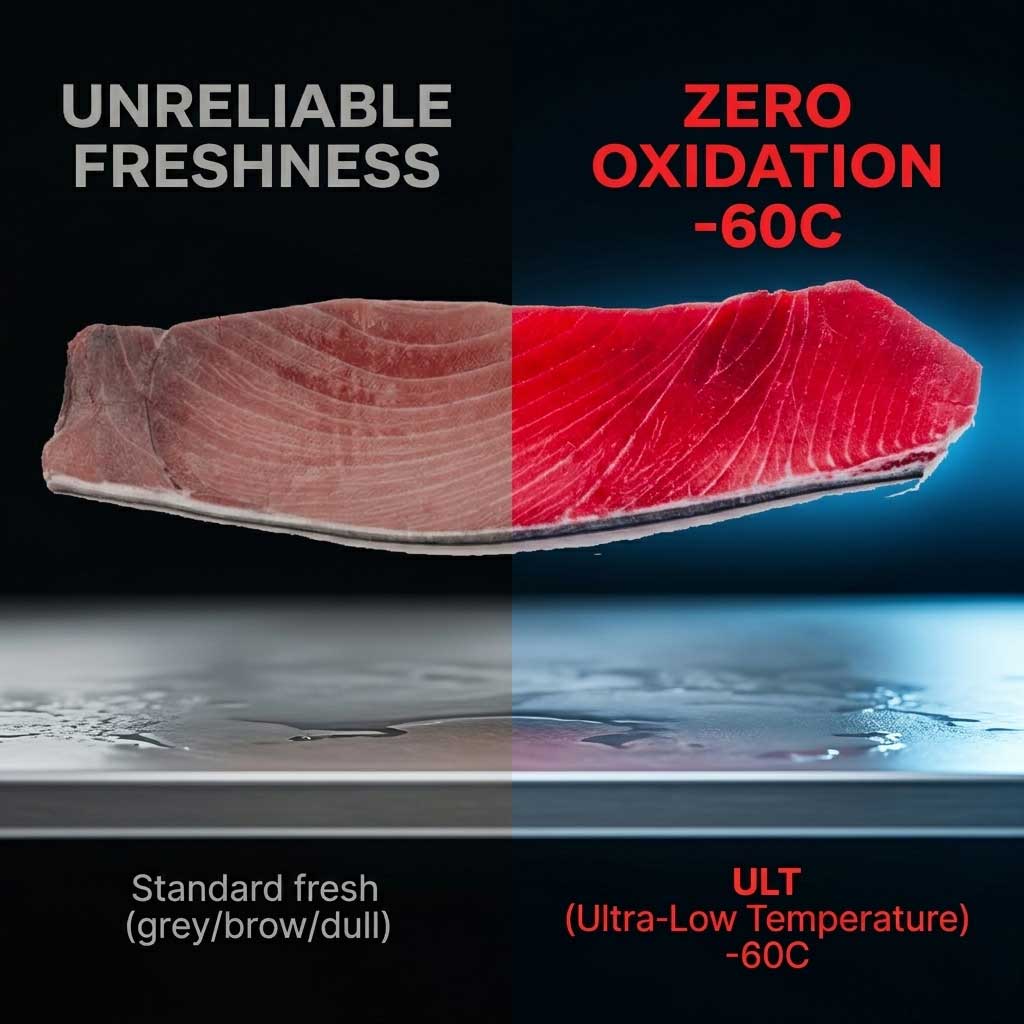
While IQF is the standard for most premium seafood, some products require even more extreme technology to maintain their peak gastronomic properties. This is where our Japanese-grade Tuna enters a category of its own.
Unlike standard commercial freezers that operate at -18°C (0°F), our tuna is subjected to Ultra-Low Temperature (ULT) freezing at -60°C (-76°F). At this extreme temperature, the “internal clock” of the fish is completely stopped.
Standard freezing often causes a change in the color and fat consistency of tuna, leading to a brownish tint and a loss of that buttery texture. However, by using -60°C technology:
- Oxidation is halted: The vibrant deep red color of the tuna is preserved naturally without the use of carbon monoxide or additives.
- Sushi-Grade Safety: This deep-freeze method is the gold standard in Japan for sashimi, as it ensures total food safety while maintaining the “melt-in-your-mouth” quality that high-end chefs demand.
- Enzymatic Stability: The natural enzymes that break down protein after harvest are totally suspended, meaning the tuna is literally “fresher” when you thaw it than a fish that has been sitting on ice for three days.
IQF Seafood From the Mediterranean to the US
At mmmediterranean, we specialize in sourcing products that utilize this technology at the source. Our Iberico pig selections and our seafood are handled with the utmost care to ensure that the flavor of Mediterranean cuisine is perfectly preserved during its journey to the United States.
How to Thaw IQF Seafood for Best Results
To maintain the IQF quality, we recommend thawing your seafood slowly in the refrigerator for 12–24 hours. This allows the fibers to reabsorb moisture naturally, ensuring a “just-caught” taste every time.
Conclusion: IQF Seafood, trusting the Process
mmmediterranean sources wild-caught seafood from Spain’s artisan harvesting regions and delivers it to American kitchens using nitrogen blast-freezing at -60°C, a Japanese-grade standard that preserves cellular integrity better than conventional freezing.
By combining the precision of IQF technology and Nitrogen Blast freezing with the extreme standards of -60°C Japanese-grade technology, we ensure that every bite of octopus, every slice of Iberico pork, and every piece of tuna tastes exactly as it would if you were sitting at a seaside table in Spain.
mmmediterranean ships IQF seafood, including wild-caught Iberico pork, Spanish octopus, and bluefin tuna, direct to U.S. doors, with every product frozen at -60°C using nitrogen blast technology to lock in flavor from harvest to delivery.